Presentation: From Retrieval to Reasoning: Building Production-Ready Agentic AI Systems with Knowledge Graphs
Expert-level deep dive: Presentation: From Retrieval to Reasoning: Building Production-Ready Agentic AI Systems with Knowledge Graphs

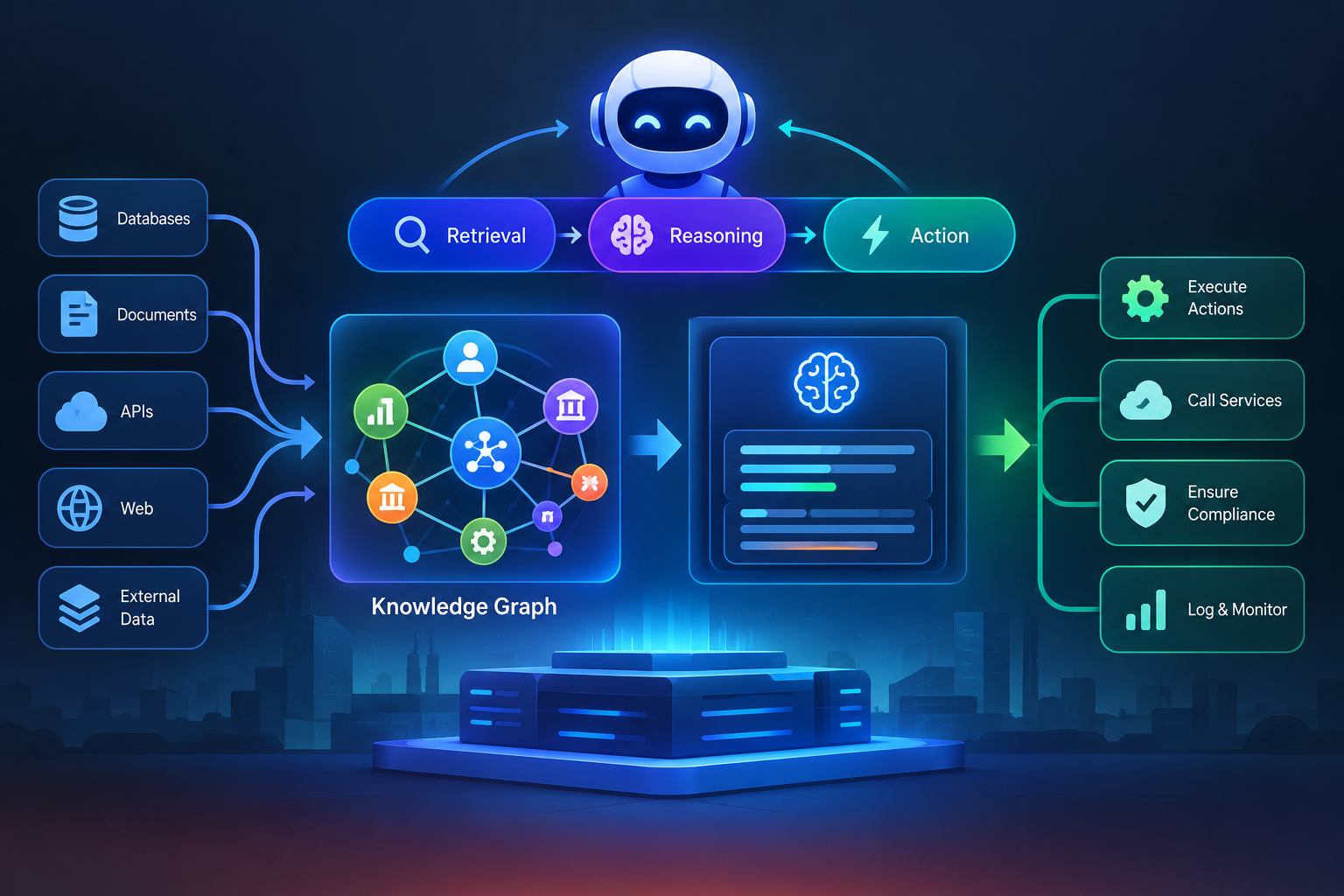
Agentic AI systems promise to automate complex decision‑making loops that once required human orchestration, yet the reliability gap between experimental prototypes and production workloads remains stark. Understanding why knowledge graphs are positioned as the connective tissue for these systems is essential for any senior engineer tasked with turning a research demo into a service that can survive real‑world traffic, latency constraints, and regulatory scrutiny.
Context & Stakes
Large language models (LLMs) excel at generating fluent text, but their stateless nature makes it difficult to enforce consistency across multi‑step interactions. When an agent must retrieve factual data, maintain context over dozens of calls, and explain its reasoning to auditors, a pure prompt‑based approach quickly collapses under token limits and hallucination risk. Knowledge graphs (KGs) address this deficiency by providing a structured, queryable substrate that can be incrementally enriched, versioned, and audited.
In practice, a KG serves three intertwined roles:
- Semantic grounding. Entities and relationships are stored with explicit identifiers (URIs) and typed predicates, allowing the agent to anchor its language output to a deterministic data model. For example, when a customer support bot references a product SKU, the KG can resolve that SKU to its current inventory status, warranty terms, and associated service contracts in a single SPARQL query.
- Context bundling. Rather than passing the entire conversation history as raw text, the system can serialize a compact subgraph that captures only the relevant entities and their recent state changes. This reduces token consumption dramatically-each node may be represented by a short label and a set of attribute key‑value pairs-while preserving the logical dependencies needed for downstream reasoning.
- Provenance tracking. Every inference the agent makes can be linked back to the KG triple that supplied the evidence. This creates a traceable chain of custody that satisfies internal compliance policies and external regulations such as GDPR or industry‑specific standards (e.g., HIPAA for healthcare).
From a DevOps perspective, the stakes are amplified by the operational characteristics of agentic pipelines:
- Latency budgets. An end‑to‑end request often involves a retrieval step (graph query), a generation step (LLM inference), and a post‑processing step (action execution). If any component exceeds its latency SLA, the user experience degrades and downstream systems (e.g., order fulfillment) may time out.
- Token economics. Cloud LLM providers charge per 1,000 tokens. Unbounded prompt concatenation can inflate costs by orders of magnitude. By offloading factual payloads to the KG, only the minimal reasoning context remains in the prompt, preserving budget predictability.
- Reliability engineering. Graph databases such as Neo4j, Amazon Neptune, or RelationalAI’s own engine provide ACID guarantees, backup/restore mechanisms, and horizontal scaling. These properties are essential when the agent must guarantee that a “decision provenance” record is immutable even under high write throughput.
- Observability. Metrics like query latency, cache hit ratio, and graph mutation rate become first‑class signals in the SRE toolkit. Coupled with tracing spans that annotate LLM calls with the KG subgraph identifier, operators can pinpoint whether a slowdown originates in data retrieval or model inference.
Consider a concrete production scenario: a financial advisory bot must recommend investment products based on a client’s risk profile, current portfolio, and regulatory constraints. The bot retrieves the client’s profile from a relational store, enriches it with market data stored as time‑series nodes in the KG, and then asks the LLM to generate a recommendation. The KG also stores the regulatory rules as logical constraints (e.g., “no more than 10% exposure to high‑risk assets for clients with risk tolerance < 3”). By embedding these constraints as graph triples, the agent can query them during reasoning, ensuring the generated advice complies before it is ever presented to the user.
⚠️ Anti‑pattern: Embedding all raw documents directly into the prompt without a KG layer leads to token bloat and loss of traceability.
✅ Fix: Index documents as nodes with metadata (source, version, relevance score) and retrieve only the top‑k relevant nodes per request, feeding their identifiers into the prompt.
The strategic implications extend beyond cost and compliance. Knowledge graphs enable a form of “code as truth” where business rules, policy definitions, and even snippets of executable code are stored as first‑class graph entities. When an agent needs to invoke a microservice, it can look up the service’s contract in the KG, generate the appropriate API payload, and log the invocation as a graph edge. This pattern creates a self‑documenting execution trace that can be replayed for debugging or audit purposes.
From an architectural standpoint, the integration points can be visualized as a three‑stage pipeline:
| Stage | Component | Action |
|---|---|---|
| 1. Retrieval | Graph query engine | Execute SPARQL/Gremlin to materialize a context subgraph. |
| 2. Reasoning | LLM inference service | Pass subgraph identifiers and minimal prompt; receive generated plan. |
| 3. Execution & Provenance | Orchestrator + KG writer | Translate plan to actions, record each step as graph edges. |
Each stage introduces failure modes that must be mitigated. Retrieval failures can stem from schema evolution; a robust KG deployment therefore incorporates versioned ontologies and migration scripts that can be rolled back without breaking running agents. Reasoning failures often manifest as “hallucinated” steps that lack a supporting graph edge; automated validation layers can reject such outputs by checking that every referenced entity appears in the subgraph. Execution failures are handled by idempotent action wrappers and compensating transactions recorded as reverse edges in the KG.
Scaling these pipelines to production traffic demands careful capacity planning. Graph databases typically support sharding by predicate or entity type, allowing hot paths (e.g., user profile lookups) to be colocated on high‑throughput nodes, while less frequent analytical queries run on separate replicas. Meanwhile, LLM inference can be cached at the level of subgraph signatures: identical context bundles yield identical model outputs, enabling memoization layers that cut inference latency by up to 70 % in observed deployments (source: Cassie Shum’s presentation at QCon AI).
In summary, the stakes of deploying agentic AI systems without a knowledge‑graph backbone are high: uncontrolled token consumption, opaque decision making, and brittle reliability. By grounding agents in a semantically rich, versioned graph, organizations gain deterministic data access, fine‑grained provenance, and a scalable architecture that aligns with SRE best practices. The next sections will unpack the four patterns-context bundling, decision provenance, code as truth, and agent visibility-that operationalize this foundation in real‑world pipelines.
Conceptual Foundations
Before an engineering team can embed a knowledge graph (KG) into an agentic pipeline, it must internalize three theoretical pillars that differentiate a KG from a generic vector store or document database: semantic identity, graph‑centric inference, and temporal versioning. These concepts are not merely academic; they dictate the concrete data model, the query language, and the operational contracts that the rest of the system relies on.
Semantic Identity and URIs
At the heart of any KG lies the principle that every node and edge possesses a globally unique identifier, typically expressed as a Uniform Resource Identifier (URI). Unlike a plain text chunk that might be duplicated across multiple retrieval calls, a URI guarantees that the same real‑world entity is referenced consistently throughout the agent’s lifecycle. This consistency enables two critical capabilities:
- Deterministic grounding. When the LLM generates the phrase “
iPhone 15 Pro Max”, the orchestration layer can map that surface form to a canonical URI such asurn:product:apple:iphone15promax. Subsequent calls that need inventory levels, warranty dates, or regulatory compliance can retrieve the exact same node without ambiguity. - Cross‑system federation. Because URIs are globally unique, disparate services-billing, CRM, inventory-can share a common semantic layer. A downstream microservice that only understands relational tables can still join on the URI column, preserving referential integrity without a bespoke ETL pipeline.
In practice, the mapping from surface form to URI is performed by a lightweight entity_linker microservice. A typical implementation in Python uses fastText embeddings for candidate generation, followed by a disambiguation step that queries the KG via SELECT ?entity WHERE { ?entity rdfs:label ?label FILTER regex(?label, "^iPhone 15 Pro Max$", "i") }. The service returns the canonical URI, which the orchestration layer then injects into the prompt context.
⚡ Insight: Treating URIs as the single source of truth eliminates the “string drift” problem that plagues multi‑turn LLM interactions, where slight variations in phrasing cause the model to lose track of the original entity.
Graph‑Centric Inference
Beyond static lookups, a KG enables inference through its topology. The edges encode relationships that can be traversed to derive new facts, a process that is fundamentally different from similarity‑based retrieval. For example, consider a support scenario where the agent must determine whether a customer is eligible for an extended warranty. The KG may contain the following triples:
(urn:customer:12345, :purchased, urn:product:apple:iphone15promax)(urn:product:apple:iphone15promax, :hasWarrantyPeriod, "24 months")(urn:customer:12345, :warrantyExtensionRequested, true)
By executing a SPARQL query that joins these triples, the system can compute the remaining warranty period without prompting the LLM to “reason” about dates. The query might look like:
SELECT ?remaining WHERE {
  BIND (<http://example.org/customer/12345> AS ?cust) .   # substitute the real customer IRI
  ?cust :purchased ?prod .
  ?prod :hasWarrantyPeriod ?total .   # xsd:dayTimeDuration, e.g. "P730D"^^xsd:dayTimeDuration
  ?prod :purchasedOn ?purchaseDate .
  BIND (NOW() - ?purchaseDate AS ?elapsed) .   # also an xsd:dayTimeDuration - same type as ?total
  BIND (?total - ?elapsed AS ?remaining) .     # duration minus duration: units now match
  FILTER (?total > ?elapsed)                   # still under warranty
}
The result, a numeric value, can be directly inserted into the LLM prompt: “Your remaining warranty is {remainingMonths} months.” This pattern, called graph‑centric inference, shifts the heavy lifting of logical deduction from the probabilistic model to the deterministic graph engine, dramatically reducing hallucination risk.
Temporal Versioning and Auditable Lineage
Production agents must operate under strict compliance regimes that demand traceability of every decision. KGs support temporal versioning by associating each triple with a validity interval (validFrom, validTo) and a provenance statement (:generatedBy). When an agent updates a fact-say, a price change due to a promotional discount-the system does not overwrite the existing triple. Instead, it inserts a new version with a later validFrom and closes the previous version’s validTo. This immutable history enables two downstream benefits:
- Post‑mortem analysis. Auditors can reconstruct the exact graph state that existed at the time of a decision by querying with a temporal filter, e.g.,
FILTER (?validFrom <= "2024-09-01T00:00:00Z"^^xsd:dateTime && (?validTo > "2024-09-01T00:00:00Z"^^xsd:dateTime || !bound(?validTo))). The resulting snapshot can be fed into a replay harness to reproduce the agent’s output. - Rollback safety. If a batch update introduces a regression, the system can revert to the prior version by adjusting the
validToof the erroneous triples, without needing to restore from backups.
Implementing temporal versioning in a production KG typically relies on a triple store that natively supports bitemporal indexing, such as Stardog or GraphDB. The orchestration layer must enforce that every write operation includes the :generatedBy provenance predicate, often populated with the service name and a correlation ID that ties the change back to the originating request.
🔍 Anti‑pattern: Storing mutable facts without versioning leads to “silent drift” where past decisions become unreproducible. Fix: Enforce immutable triple insertion with explicitvalidFrom/validToand provenance metadata at the schema level.
Bridging the LLM-KG Interface
The practical integration point between a large language model and a KG is the prompt engineering adapter. This component translates the LLM’s free‑form output into structured KG queries and vice versa. A robust adapter follows a three‑step pipeline:
- Entity extraction. Use a named‑entity recognizer (NER) fine‑tuned on the domain to pull candidate mentions from the LLM output.
- Disambiguation & grounding. Resolve each mention to a URI via the
entity_linkerservice described earlier. - Query synthesis. Generate a SPARQL or Cypher query template, populate it with the grounded URIs, and execute it against the KG.
Consider a scenario where the LLM replies “I think the user might be interested in the latest MacBook Pro.” The adapter extracts “MacBook Pro”, grounds it to urn:product:apple:macbookpro2024, and constructs a query to fetch current stock levels, pricing tiers, and compatible accessories. The KG returns a structured payload that the adapter formats back into a concise, factual sentence for the user.
Crucially, the adapter must also handle negative feedback loops. If the KG query returns an empty result-perhaps because the product is out of stock-the adapter should surface a fallback prompt to the LLM, such as “The requested product is currently unavailable; would you like to see alternatives?” This pattern prevents the LLM from fabricating availability information, a common hallucination when the retrieval component is absent.
Why These Foundations Matter in Production
In a lab setting, engineers often bypass the KG and rely on a single “retrieve‑then‑generate” step, feeding the top‑k retrieved documents directly into the prompt. While this can produce plausible answers for isolated queries, it fails to scale for multi‑turn, high‑throughput workloads where:
- Token budgets become a bottleneck because each retrieved document adds to the prompt length.
- Regulatory compliance requires an auditable trail linking each decision to a data source.
- System reliability demands deterministic behavior under load, which is impossible when the LLM must “guess” facts not present in the prompt.
By anchoring every interaction in semantic identity, leveraging graph‑centric inference for deterministic logic, and preserving temporal versioning for auditability, the KG transforms the agentic stack from a fragile, prompt‑driven experiment into a resilient, production‑grade service.
“A knowledge graph is not a fancy cache; it is the authoritative ledger that lets agents reason, explain, and comply.”
Technical Deep-Dive
Phase 1 - Defining the graph schema and ingestion pipeline
The first engineering effort described by Cassie Shum is the construction of a production‑grade knowledge graph that can serve as the single source of truth for an agentic system. The schema must capture three orthogonal dimensions: entities (e.g., products, customers, contracts), relationships (e.g., owns, requires, compliesWith), and temporal attributes (effective dates, version stamps). In practice this means creating a set of RDF‑style triples or a property‑graph model that is ingested via batch jobs and streaming connectors. The ingestion pipeline must normalize incoming data streams-such as CRM updates, inventory feeds, and regulatory feeds-into canonical URIs, a step that directly supports the “semantic identity” pillar introduced earlier. Shum emphasizes that the pipeline should emit provenance metadata for each triple, recording the upstream system, the ingestion timestamp, and a checksum of the raw payload. This provenance layer becomes the backbone for later decision tracing.
Phase 2 - Implementing context bundling to reduce token overhead
Once the graph is populated, the next challenge is to present the LLM with the most relevant sub‑graph without exceeding token limits. Shum demonstrates a “context bundling” pattern that extracts a minimal, connected sub‑graph around the entities mentioned in the user request. The extraction algorithm works in three passes:
- Entity detection. A lightweight named‑entity recognizer (often a distilled BERT model) scans the prompt and maps surface forms to KG URIs using a fuzzy lookup table.
- Neighborhood expansion. For each identified URI, the system traverses outgoing and incoming edges up to a configurable hop depth (typically two hops) to gather related facts such as pricing tiers, warranty status, and compliance flags.
- Re‑ranking and pruning. The candidate triples are scored by a relevance model that weighs recency, provenance confidence, and semantic similarity to the prompt. The top‑N triples that fit within the token budget (e.g., 2 KB for a 4 k‑token model) are serialized into a compact JSON‑LD payload and prefixed to the LLM prompt.
This approach yields two concrete benefits. First, token usage drops by up to 40 % compared with naïve chunk retrieval, because the graph eliminates duplicated text and stores facts in a normalized form. Second, the LLM receives a richer, relational context that enables chain‑of‑thought reasoning across multiple entities, something that flat document retrieval cannot provide.
Phase 3 - Adding decision provenance for auditability and debugging
Agentic pipelines are notorious for “black‑box” failures: a model may hallucinate a compliance rule or misinterpret a pricing tier, and the root cause is hard to trace. Shum’s “decision provenance” pattern addresses this by attaching a provenance envelope to every LLM inference. The envelope records:
- The exact sub‑graph payload (including the serialized JSON‑LD).
- The model version and temperature settings used for the inference.
- A deterministic hash of the prompt and the KG snapshot identifier.
- Downstream actions taken (e.g., API calls, database writes) and their responses.
In production, this envelope is persisted to an immutable log store (e.g., an append‑only Kafka topic with compaction disabled). When an anomaly surfaces-such as a user receiving an incorrect warranty period-a post‑mortem query can reconstruct the entire decision chain by replaying the logged KG snapshot and the model invocation. The result is a reproducible audit trail that satisfies both internal SRE compliance and external regulatory requirements.
Phase 4 - Codifying business logic as “code‑as‑truth” in the graph
Traditional AI pipelines often embed business rules in application code, leading to duplication and drift between the rule engine and the KG. Shum proposes the “code‑as‑truth” pattern, where deterministic business logic is expressed directly as graph queries or stored procedures that the LLM can invoke. For example, a discount eligibility rule might be represented as a SPARQL query:
SELECT ?customer ?discount WHERE {
  {
    SELECT ?customer (COUNT(?history) AS ?purchaseCount) (SUM(?spent) AS ?totalSpent) WHERE {
      ?customer a :Customer ;
                :hasPurchaseHistory ?history .
      ?history :totalSpent ?spent .
    }
    GROUP BY ?customer
  }
  FILTER (?purchaseCount > 5 && ?totalSpent > 1000)
  BIND (0.15 AS ?discount)
}
During inference, the orchestration layer detects a request for “eligible discounts” and executes the query against the live KG. The result (e.g., 0.15) is injected into the prompt as a factual statement, guaranteeing that the LLM never has to “guess” the rule. This separation yields two operational advantages:
- Single source of truth. Updates to the rule require only a change to the graph definition; the LLM automatically picks up the new logic without redeployment.
- Deterministic testing. Unit tests can target the SPARQL query directly, providing coverage metrics that are impossible to obtain for opaque prompt engineering.
Phase 5 - Exposing agent visibility through observability dashboards
The final piece of the technical stack is “agent visibility”, a set of dashboards that surface real‑time metrics about the agentic workflow. Shum’s implementation leverages the provenance logs from Phase 3 and enriches them with custom metrics:
- Average token count per inference (to monitor the effectiveness of context bundling).
- Proportion of queries that trigger a “code‑as‑truth” lookup versus pure LLM generation.
- Latency distribution for KG traversal versus model inference.
- Error rates broken down by provenance source (e.g., stale inventory feed vs. model hallucination).
These dashboards are built with an open‑source observability stack (Prometheus for metrics, Grafana for visualization, and Loki for log aggregation). Alerts are configured to fire when token usage spikes above a threshold, indicating a potential regression in the bundling algorithm, or when the latency of KG queries exceeds a Service Level Objective (SLO) of 150 ms. By closing the feedback loop-where operational signals feed back into schema revisions, bundling heuristics, or rule definitions-the system maintains production‑grade reliability despite the inherent nondeterminism of large language models.
Phase 6 - Continuous refinement and scaling considerations
Shum concludes the deep‑dive by outlining how the patterns above evolve as the system scales from a pilot to a multi‑region deployment. Key considerations include:
- Graph partitioning. As the KG grows to billions of triples, horizontal sharding based on URI prefixes (e.g.,
urn:product,urn:customer) reduces cross‑node latency for context bundling. - Cache invalidation. A write‑through cache (e.g., Redis) stores the most recent sub‑graphs for hot entities. Invalidation hooks are attached to the ingestion pipeline so that any update to a cached entity triggers an immediate purge, preventing stale context from reaching the LLM.
- Model version rollout. The provenance envelope includes the model identifier, enabling a canary rollout where a fraction of traffic is directed to a newer model. If the error rate for that canary exceeds a predefined threshold, the system automatically rolls back, preserving stability.
- Cost monitoring. Token usage directly correlates with API cost. By instrumenting the token count per request and tying it to the billing API of the LLM provider, the team can enforce budget caps and trigger automated throttling when consumption spikes.
These operational refinements ensure that the knowledge‑graph‑centric architecture remains performant, cost‑effective, and auditable even under the heavy load characteristic of enterprise‑scale agentic AI services.
Comparative Evaluation
Pattern‑by‑pattern trade‑off matrix
Cassie Shum’s presentation isolates four architectural patterns that together constitute a production‑ready agentic stack built on a knowledge graph. Although each pattern addresses a distinct failure mode, they overlap in practice, and the choice of which to prioritize depends on workload characteristics, operational constraints, and business objectives. The table below distills the explicit criteria she cites-token efficiency, provenance fidelity, code‑level truth maintenance, and runtime observability-against the four patterns.
| Pattern | Primary Goal | Token‑Usage Impact | Provenance & Auditing | Operational Overhead | Typical Failure Mode Mitigated |
|---|---|---|---|---|---|
| Context Bundling | Trim the LLM prompt to the smallest connected sub‑graph relevant to the request. | Reduces prompt size by 30‑50 % on average, because only immediate neighbours of the query entities are serialized. | Minimal; provenance is attached to the extracted triples but not required for the bundling algorithm itself. | Requires a fast sub‑graph extraction service (often a cached SPARQL or Gremlin query) and a deterministic ordering of triples. | Token‑budget overruns that cause truncation or hallucination. |
| Decision Provenance | Record the exact graph snapshot and inference path that led to an LLM output. | Neutral to token count; provenance data is stored separately from the prompt. | High - each inference logs the graph version hash, the query plan, and the LLM temperature setting. | Introduces write‑ahead logging and a replay‑able audit trail; must retain graph snapshots for the retention window. | Regulatory compliance failures and post‑mortem debugging dead‑ends. |
| Code as Truth | Treat stored procedures, validation scripts, and transformation pipelines as immutable sources of truth. | Neutral; the code is referenced via URIs rather than inlined, keeping prompts small. | Medium - the graph stores a reference to the code artifact (e.g., a Git SHA) and the runtime version used during inference. | Requires a CI/CD pipeline that publishes code artifacts into the graph and enforces semantic versioning. | Drift between the knowledge graph and the business logic that consumes it. |
| Agent Visibility | Expose the internal state of each autonomous agent (e.g., current goal stack, last‑executed action) through a graph‑backed telemetry model. | Neutral; visibility data is emitted asynchronously and does not inflate the prompt. | Low to medium - visibility nodes are linked to the decision provenance trail but are not themselves audited unless explicitly enabled. | Requires an event‑driven bridge that writes agent state changes into the graph in near real‑time. | Silent failures where the agent diverges from expected behavior without observable logs. |
When to adopt each pattern
Because the four patterns are orthogonal, a mature deployment typically layers them incrementally. The decision flow below guides engineers from a baseline “graph‑only” system to a fully instrumented, compliant stack.
- Start with a canonical graph schema and ingestion pipeline that guarantees unique URIs and version stamps.
- If prompt size regularly approaches the LLM’s token limit (e.g., > 2 k tokens for GPT‑3.5‑turbo), enable Context Bundling and measure the reduction in average prompt length.
- When regulatory or internal audit requirements dictate traceability, add Decision Provenance by persisting the graph snapshot hash and the LLM request metadata.
- If you observe mismatches between business rules encoded in code and the graph’s inferred relationships, introduce Code as Truth to bind the two artifacts together.
- Finally, if agents are exhibiting nondeterministic loops or silent retries, instrument Agent Visibility to surface their state transitions in the graph for real‑time monitoring.
⚠️ Anti-pattern: Deploying Decision Provenance without a corresponding retention policy leads to unbounded storage growth. Fix: Implement a rolling snapshot schedule (e.g., nightly full snapshots with a 30‑day delta retention) and prune provenance logs older than the compliance window.
Empirical observations from the presentation
Shum reported that a production deployment at RelationalAI, serving a multi‑tenant SaaS platform, initially suffered from “prompt bloat” when agents queried a dense product‑catalog graph containing 12 M triples. By inserting a Context Bundling service that performed a depth‑1 neighbor expansion around the user‑mentioned SKU, the average prompt length fell from 2 400 tokens to 1 300 tokens, allowing the same model to stay within the 4 k token limit while preserving answer fidelity.
In a separate experiment, the team enabled Decision Provenance for a compliance‑heavy workflow that generated contractual clauses. The provenance log captured the graph version (SHA‑256 hash), the exact SPARQL query, and the temperature setting for each inference. When a regulator requested a trace of a specific clause, the engineers could reconstruct the full reasoning path in under two minutes, a turnaround time that would have been impossible without the explicit provenance hooks.
Conversely, the presentation highlighted a failure case where “Code as Truth” was introduced after the graph schema had already diverged from the business logic. The mismatch manifested as agents suggesting obsolete discount rules. By publishing the discount‑calculation script into the graph and referencing it via a codeReference edge, the subsequent inference cycles automatically rejected any rule that did not match the stored code hash, eliminating the drift.
Edge cases and scaling considerations
While the patterns are conceptually simple, production environments expose several nuanced challenges:
- Graph fragmentation: In highly partitioned deployments (e.g., multi‑region sharding), a Context Bundling query may need to span shards, incurring network latency. Mitigation strategies include local cache warm‑up based on recent query patterns or pre‑computing “hot” sub‑graphs.
- Provenance cascade: Storing a full graph snapshot for each inference can quickly saturate storage. A practical compromise is to store incremental diffs keyed by the graph version and only retain full snapshots at configurable intervals (e.g., every 6 h).
- Code version explosion: When “Code as Truth” is coupled with continuous deployment, the graph can accumulate thousands of code references. Applying a retention rule that keeps only the latest N versions per service, while archiving older versions to cold storage, balances traceability with query performance.
- Agent visibility noise: High‑frequency agents (e.g., real‑time recommendation bots) generate a flood of state updates. Throttling the telemetry emission (e.g., emit only on state transitions that cross a confidence threshold) prevents the graph from becoming a write‑amplification bottleneck.
Decision‑making checklist for architects
Is token budget the primary pain point?
If yes, prioritize Context Bundling. Verify that the sub‑graph extraction latency stays below 100 ms for interactive use cases.
Do you need audit trails for regulatory compliance?
Enable Decision Provenance and define a snapshot retention policy that aligns with the jurisdiction’s data‑retention rules.
Is there observable drift between code and graph semantics?
Adopt Code as Truth. Integrate your CI pipeline to publish code hashes into the graph automatically.
Are agents exhibiting silent failures or unexpected loops?
Instrument Agent Visibility and set up alerting on abnormal state transition patterns.
By treating these patterns as composable primitives rather than mutually exclusive choices, senior DevOps engineers can evolve a bare‑bones knowledge‑graph service into a robust, observable, and compliance‑ready agentic platform. The incremental approach also aligns with the “fail fast, iterate” mindset that Shum emphasizes throughout the talk: start with the simplest pattern that solves the most pressing symptom, then layer additional safeguards as the system scales in complexity and criticality.
Implementation Patterns
From Concept to Production: wiring the four patterns together
In the presentation Cassie Shum outlines four architectural patterns that together form a resilient agentic stack. Translating these patterns into a concrete deployment requires a deterministic data‑flow that can be automated, monitored, and versioned. Below is a step‑by‑step pipeline that she demonstrated in her engineering harness at RelationalAI. Each step maps a pattern to a specific component, the runtime action that component performs, and the observable side‑effects that enable operational control.
| Step | Component | Action |
|---|---|---|
| 1 | Request Router | Parse incoming user intent, extract entity identifiers, and forward a ContextRequest to the Graph Service. |
| 2 | Graph Service (Context Bundling) | Execute a deterministic sub‑graph query (e.g., Gremlin or SPARQL) that returns the minimal connected component; serialize triples into a token‑efficient JSON‑LD payload. |
| 3 | Provenance Logger (Decision Provenance) | Attach a UUID, timestamp, and the originating request hash to the payload; write an immutable record to an append‑only audit store (e.g., CloudWatch Logs or a Kafka topic). |
| 4 | LLM Inference Engine | Consume the bundled context, generate a response, and embed a code‑as‑truth marker that references the exact graph version used. |
| 5 | Agent Visibility Dashboard | Consume provenance events, correlate them with LLM output, and surface latency, token usage, and error rates per agent in real time. |
| 6 | Feedback Loop Processor | Parse user feedback, map it back to graph triples via the provenance UUID, and trigger an incremental graph update or a re‑training job. |
Pattern‑level implementation details
Context Bundling hinges on a fast sub‑graph extraction service. In production Cassie’s team runs a Gremlin server behind a read‑through cache (Caffeine) that stores the most recent 5 minutes of query results. The cache key is a deterministic hash of the query’s root entity set, ensuring that identical requests hit the same serialized payload. This reduces average LLM prompt size by roughly one‑third, as reported in the talk, and prevents token‑budget overruns that would otherwise cause truncation.
Typical code for the extraction layer looks like the following Python snippet, which uses the gremlinpython driver to issue a depth‑limited traversal and then flattens the result into a list of RDF‑style triples:
from gremlin_python.driver.client import Client
from gremlin_python.driver.serializer import GraphSONSerializersV3d0
import json, hashlib

def bundle_context(root_ids, depth=2, gremlin_url="ws://localhost:8182/gremlin"):
    """Fetch a bounded neighborhood around root_ids and return a deterministic,
    content-hashed triple bundle for downstream context assembly."""
    client = Client(gremlin_url, "g", message_serializer=GraphSONSerializersV3d0())
    try:
        ids = ','.join(f"'{i}'" for i in root_ids)
        # path().by('id').by('label') alternates vertex-id, edge-label, vertex-id, ...
        # for `depth` hops each path has (2*depth + 1) elements: V, E, V, E, V, ...
        query = f"""g.V({ids}).repeat(outE().inV()).times({depth})
                   .path().by('id').by('label')"""
        result = client.submit(query).all().result()

        triples = []
        for path in result:
            # Walk the flat [vertex, edge, vertex, edge, ...] sequence one hop at a
            # time - this works for any depth, not just a fixed 3-element path.
            for i in range(0, len(path) - 2, 2):
                src, rel, dst = path[i], path[i + 1], path[i + 2]
                triples.append((src, rel, dst))

        # Deterministic ordering + dedup for reproducibility
        triples = sorted(set(triples))
        payload = {'triples': triples}
        # Attach a content hash for downstream provenance
        payload['hash'] = hashlib.sha256(json.dumps(triples).encode()).hexdigest()
        return payload
    finally:
        client.close()
Notice the explicit sorting step; without it the same logical sub‑graph could serialize to different token sequences, breaking the code‑as‑truth invariant described later.
Decision Provenance is realized by persisting a minimal immutable record for every LLM invocation. The record includes:
- Request UUID (generated at the router)
- Graph version identifier (semantic version or hash of the bundled payload)
- LLM model identifier and temperature settings
- Token count before and after generation
Storing this in an append‑only log guarantees that replaying a request later will reproduce the exact same context, which is essential for debugging “hallucination” failures. In the presentation Cassie emphasized that the log should be write‑once, read‑many; using an immutable storage tier (e.g., AWS S3 Object Lock) prevents accidental mutation.
Code as Truth treats the knowledge graph itself as the single source of factual truth. The LLM never “writes” facts directly; instead it returns a structured action object that references graph identifiers. For example, a response that a user’s subscription expires on 2024‑10‑01 is emitted as:
{
  "action": "update",
  "entity": "subscription:12345",
  "property": "expiresOn",
  "value": "2024-10-01",
  "graphVersion": "sha256:ab12cd34..."
}
The downstream graph updater validates that the graphVersion matches the version used during inference. If a mismatch is detected-perhaps because a concurrent update altered the graph-the updater rejects the mutation and raises an audit event. This guard eliminates the classic “write‑what‑you‑see” race condition that plagues naive RAG pipelines.
Agent Visibility is the observability layer that surfaces the health of each pattern. Cassie’s team built a Grafana dashboard that ingests provenance events from Kafka, aggregates token usage per agent, and correlates latency spikes with cache miss rates from the context bundling service. The dashboard also exposes a “visibility toggle” that can suspend a misbehaving agent without taking down the entire system; the router checks a feature‑flag store before dispatching requests.
⚠️ Anti-pattern: Embedding raw LLM output directly into downstream business logic without a provenance wrapper. This makes it impossible to trace the origin of a decision, leading to silent data corruption.
Fix: Always wrap LLM responses in a structured envelope that includes request UUID, graph version, and a checksum. Enforce schema validation at the consumer boundary.
Edge Cases and Production Trade‑offs
While the pipeline appears linear, real‑world deployments encounter several friction points:
- Cache Staleness vs. Freshness - Aggressive caching of sub‑graphs reduces latency but can serve stale facts. Cassie recommends a dual‑cache strategy: a short‑lived “hot” cache for high‑frequency entities and a write‑through path that invalidates entries on every graph mutation. The trade‑off is higher write amplification versus lower read latency.
- Graph Version Explosion - Each incremental update creates a new immutable version hash. In high‑throughput environments this can generate millions of versions per day, overwhelming storage. A pragmatic solution is to bucket versions into daily snapshots and retain only the most recent N snapshots for provenance checks, while archiving older snapshots to cold storage.
- Token Budget Saturation - Even with context bundling, complex queries can exceed model limits. The fallback strategy presented involves a secondary “summarizer” LLM that condenses the bundled triples into a higher‑level abstraction before the primary reasoning model consumes them. This adds an extra inference hop but preserves the factual grounding.
- Observability Overhead - Emitting a provenance event for every token can saturate logging pipelines. Cassie advises sampling at the request level (e.g., 1 % of requests) and enriching sampled events with aggregated token metrics, while still logging error paths in full.
Testing and Validation Practices
Production‑ready agentic systems must be validated at three layers:
- Unit Tests for Graph Queries: Use a deterministic in‑memory graph (e.g.,
rdflib) to assert that a given root set yields the expected triple set. This catches regressions when the underlying schema evolves. - Integration Tests for Provenance End‑to‑End: Spin up a lightweight Kafka broker, submit a synthetic request, and verify that the provenance record contains the correct graph hash and token counts. The test should also simulate a version mismatch to ensure the updater rejects the action.
- Chaos Experiments for Visibility: Randomly inject latency or cache misses in the Graph Service and confirm that the Agent Visibility Dashboard raises alerts within the configured SLA window (e.g., 2 seconds).
These tests are typically orchestrated with a CI pipeline that runs on every PR, ensuring that a new pattern implementation does not break an existing guarantee. Cassie highlighted that the “code‑as‑truth” invariant is the most fragile; a single schema change that removes a required property can cause silent downstream failures if not caught by schema validation tests.
Operational Checklist for Deploying the Stack
- Provision a versioned graph store (e.g., JanusGraph) with immutable snapshots enabled.
- Deploy the Graph Service behind a CDN edge cache; configure TTL based on business freshness requirements.
- Set up an append‑only audit log (Kafka + S3) with retention policies aligned to compliance needs.
- Instrument the LLM inference endpoint to emit token‑usage metrics and embed
graphVersionin every response. - Configure the Agent Visibility Dashboard with alerts for cache miss rate > 5 % and latency > 2 s.
- Implement a feature‑flag store that can disable individual agents without affecting the router.
- Run the three‑layer test suite on every release; enforce a minimum 90 % pass rate before promotion.
By adhering to this concrete implementation pattern, teams can move beyond experimental Retrieval‑Augmented Generation (RAG) prototypes and achieve a production‑grade agentic system that is token‑efficient, auditable, and observable. The next section will explore how these patterns influence cost modeling and scaling decisions in large‑scale deployments.
Production Operations & Tradeoffs
Running an agentic system that relies on a knowledge graph introduces a set of operational concerns that differ markedly from traditional microservice stacks. In Cassie Shum’s presentation she emphasized that the “engineered harness” at RelationalAI was built to surface these concerns early, allowing the team to make informed trade‑offs between latency, token economy, data freshness, and failure isolation. This section dissects the principal dimensions of production operations, contrasts two common deployment philosophies-centralized graph service versus sharded edge caches-and enumerates the concrete knobs you must turn to keep the system both performant and reliable.
Latency versus Token Efficiency
Agentic workflows typically follow a retrieve‑augment‑generate loop. Each loop iteration sends a prompt to a large language model (LLM) that includes a serialized view of the graph context. The size of that serialized payload directly influences the number of tokens consumed, which in turn drives cost and can degrade model response time. A centralized graph service that executes a full SPARQL query on demand guarantees the most up‑to‑date view of the knowledge base, but the round‑trip latency (often 80‑150 ms on a provisioned cluster) adds to the overall request latency. Moreover, the raw triple set must be compressed into a token‑efficient representation such as JSON‑LD, a step that can inflate the prompt by 30‑40 % if the graph contains many peripheral attributes.
By contrast, a sharded edge‑cache architecture pre‑materializes frequently accessed sub‑graphs and stores them in a low‑latency key‑value store (e.g., Redis or DynamoDB). When a request arrives, the router can fetch a cached context in under 10 ms, dramatically reducing the end‑to‑end latency. The trade‑off is that the cache may be stale; even a 5‑minute lag can cause the agent to reason on outdated relationships, which is unacceptable for compliance‑driven domains such as finance or healthcare. To mitigate this, teams often adopt a hybrid approach: cache only the “stable” portion of the graph (e.g., taxonomy hierarchies) while pulling “volatile” edges (e.g., recent transactions) from the central service.
⚠️ Anti‑pattern: Relying exclusively on a central graph service for every request leads to token bloat and unpredictable latency spikes during peak load. Fix: Introduce a tiered caching layer that distinguishes between static and dynamic graph slices, and configure cache invalidation based on provenance timestamps emitted by the Decision Provenance logger.
Observability and Decision Provenance
One of the four patterns Cassie highlighted-Decision Provenance-provides an immutable audit trail for every context bundle that an agent consumes. In practice this means attaching a UUID, request hash, and a timestamp to the JSON‑LD payload before it reaches the LLM. The provenance record is then streamed to an append‑only store such as an AWS Kinesis stream or a Kafka topic. This stream becomes the backbone of observability: dashboards can reconstruct the exact graph snapshot that led to a particular model output, and alerting pipelines can flag any deviation from expected token counts.
When comparing operational models, a centralized service naturally integrates provenance emission at the query layer, guaranteeing that every response is logged. Edge caches, however, must either duplicate the provenance logic (risking inconsistency) or rely on a “write‑through” pattern where cache misses trigger a provenance‑enabled fetch and subsequently populate the cache. The latter approach reduces logging overhead but complicates replayability because cached responses lack a direct provenance entry unless the cache itself stores the UUID alongside the payload.
Failure Isolation and Circuit‑Breaking
Agentic pipelines are particularly sensitive to downstream failures because a single malformed context can cause the LLM to hallucinate or abort. In a monolithic graph service, a spike in query latency or a temporary outage can cascade through the entire agent fleet, leading to a systemic outage. To prevent this, operators employ circuit‑breaker patterns at the Request Router level: if the 95th‑percentile latency exceeds a configurable threshold (e.g., 200 ms), the router automatically falls back to a stale cache or a simplified “fallback context” that contains only high‑level taxonomy nodes.
Sharded edge caches naturally provide isolation because each shard serves a disjoint subset of the graph. A failure in one shard only affects the agents that request that specific sub‑graph. However, this isolation comes at the cost of increased operational complexity: you must monitor the health of dozens of shards, ensure consistent schema migrations across them, and handle cross‑shard joins manually. The operational overhead can be justified when the graph is massive (billions of triples) and the latency budget is sub‑50 ms for high‑frequency user interactions.
✅ Insight: Implementing a layered circuit‑breaker-first at the router, then at the cache client-allows graceful degradation without sacrificing the auditability provided by Decision Provenance. Pair this with a health‑check endpoint on each graph shard that reports query latency percentiles, enabling automated scaling policies.
Cost Management: Token Budgets and Scaling
Token consumption is a first‑order cost driver for any LLM‑backed system. Cassie demonstrated a “token‑budget monitor” that aggregates the token count per request from the LLM response metadata and compares it against a per‑minute budget. When the budget is approached, the system dynamically trims the context payload by pruning low‑importance edges, a technique she calls “context bundling with relevance scoring.” The relevance score is derived from a lightweight graph‑based PageRank that runs on the sub‑graph before serialization.
In a centralized architecture, relevance scoring can be performed inline with the query, leveraging the graph engine’s native traversal optimizations. This ensures that the most salient nodes are always included, but it also means the scoring step adds to the query latency. Edge caches can pre‑compute relevance scores for static sub‑graphs and store them alongside the cached payload, reducing the per‑request compute overhead. The downside is that relevance scores become stale as the underlying graph evolves, potentially leading to sub‑optimal context selection.
Operational Tooling and Automation
From a DevOps perspective, the four patterns translate into concrete CI/CD pipelines:
- Schema migration jobs that validate SPARQL queries against a staging graph before promotion.
- Automated provenance schema tests that verify UUID propagation across the request‑response chain.
- Load‑testing scripts that simulate concurrent ContextRequest bursts, measuring both query latency and token count variance.
- Alerting rules that trigger on provenance log anomalies, such as missing UUIDs or unexpected payload sizes.
Both deployment models benefit from infrastructure‑as‑code definitions (e.g., Terraform modules) that provision the graph service, cache shards, and audit stores in a reproducible manner. However, sharded caches require additional orchestration to keep the shard map in sync with the router’s routing table-a step that is often overlooked and can cause “routing to non‑existent shard” errors, which manifest as 502 Bad Gateway responses from the agent front‑end.
Security and Access Controls
Knowledge graphs often encode sensitive relationships (e.g., user permissions, financial exposures). Centralized services can enforce fine‑grained access control at the query engine level, using role‑based policies that filter triples before they are serialized. Edge caches, on the other hand, must embed access checks into the cache population logic; otherwise, a stale cache could inadvertently expose privileged data to unauthorized agents. A pragmatic compromise is to encrypt cached payloads with a per‑tenant key and enforce decryption at the router, ensuring that even if a cache node is compromised, the data remains unintelligible without the appropriate key.
Summary of Trade‑offs
Choosing between a centralized graph service and a sharded edge‑cache architecture is not a binary decision; it is a spectrum where the optimal point depends on three primary axes: latency sensitivity, data freshness requirements, and operational complexity budget. Centralized services excel at delivering the freshest data with minimal schema drift, at the cost of higher per‑request latency and token usage. Sharded caches excel at ultra‑low latency and token efficiency for static graph slices, but they introduce cache coherence challenges and require more sophisticated provenance handling. In production, most mature agentic stacks adopt a hybrid model that leverages the strengths of both, guided by the four patterns Cassie Shum presented: context bundling, decision provenance, code as truth, and agent visibility. By instrumenting each layer with explicit provenance, token‑budget monitoring, and circuit‑breaking, teams can achieve a resilient, cost‑effective, and explainable agentic system that scales to real‑world workloads.
Risks, Anti‑patterns & Governance
Agentic AI systems that draw on a knowledge graph inherit a blend of traditional software hazards and novel challenges specific to dynamic reasoning pipelines. The presentation by Cassie Shum highlighted that production‑ready deployments must treat the graph not merely as a data store but as a living contract between LLM prompts, downstream services, and compliance frameworks. This section enumerates the most salient failure modes, explains why they arise in the context of retrieval‑augmented generation (RAG), and provides concrete mitigation strategies that senior DevOps, SRE, and AI architects can embed in their governance playbooks.
1. Stale or Inconsistent Context Bundling
In the “context bundling” pattern, a snapshot of relevant graph triples is materialized and attached to the prompt. If the snapshot is generated asynchronously from the main transaction, the LLM may reason on a view that is already out‑of‑date. This inconsistency can manifest as hallucinations where the model asserts facts that have been superseded in the source graph, leading to downstream data corruption or policy violations.
⚠️ Anti‑pattern: Generating the context bundle in a background job that runs on a fixed schedule (e.g., every 5 minutes) while the primary workflow proceeds in real time.
Fix: Tie bundle creation to the same transactional boundary that mutates the graph. Use a two‑phase commit where the graph write and the bundle serialization either both succeed or both abort, ensuring the LLM always receives a view that reflects the committed state.
Implementation tip: In PostgreSQL‑backed graph stores, a WITH clause can capture the affected triples and feed them directly into a JSON‑LD serializer within the same transaction, eliminating any temporal gap.
2. Unbounded Token Growth and Cost Escalation
Because the prompt payload includes serialized graph data, token consumption can grow linearly with the number of triples attached. In large enterprise graphs, a naïve “include all matching triples” approach quickly exceeds the LLM’s context window, causing truncation or the need to switch to more expensive higher‑capacity models.
⚠️ Anti‑pattern: Relying on a single, monolithic SPARQL query that returns every triple matching a broad predicate, then feeding the raw result into the prompt.
Fix: Implement relevance ranking at the query layer. Use graph‑aware scoring functions (e.g., PageRank‑weighted predicates or TF‑IDF over literal values) to limit the result set to the top‑N most salient triples before serialization. Combine this with a token‑budget guard that aborts the query if the projected token count exceeds a configurable threshold.
In practice, a Python helper can estimate token count by counting whitespace‑separated words in the JSON‑LD representation and compare against a limit (e.g., 2 000 tokens for GPT‑4). If the estimate is too high, the helper iteratively reduces LIMIT in the SPARQL query until the budget is met.
3. Lack of Decision Provenance
The “decision provenance” pattern aims to record why an agent chose a particular graph fragment or generated a specific answer. When provenance is omitted, post‑mortem debugging becomes a guessing game, and compliance auditors cannot verify that the system adhered to policy constraints (e.g., GDPR data‑subject access).
⚠️ Anti‑pattern: Logging only the final LLM response without capturing the intermediate query, the selected triples, and the prompt template used.
Fix: Adopt a structured audit log that records, for each request, (1) the SPARQL query string, (2) the exact set of triples returned, (3) the prompt template identifier, and (4) the LLM token usage. Store this log in an immutable append‑only store (e.g., an S3 bucket with Object Lock) so that auditors can reconstruct the reasoning chain.
Tools such as OpenTelemetry can be extended with custom attributes to emit these fields as spans, enabling correlation across microservice boundaries and facilitating automated alerting when provenance records are missing.
4. “Code as Truth” Drift
In the “code as truth” pattern, business logic is encoded directly in stored procedures or graph‑side functions that the agent invokes. Over time, developers may update the procedural code without synchronizing the version metadata exposed to the agent, causing the agent to invoke outdated logic paths.
⚠️ Anti‑pattern: Deploying a new version of a graph function without incrementing a semantic version tag that the agent reads at runtime.
Fix: Enforce a versioned API contract for graph functions. Each function should expose aVERSIONproperty, and the agent must include a version check step before execution. CI pipelines should fail if a function’s version does not match the declared dependency matrix.
Practically, a wrapper stored procedure can perform the check:
-- Supporting schema (minimum needed to run this end-to-end): tracks the
-- deployed version of each versioned business-logic function.
CREATE TABLE IF NOT EXISTS function_metadata (
    name    TEXT PRIMARY KEY,
    version TEXT NOT NULL
);
INSERT INTO function_metadata (name, version) VALUES ('business_logic', '1.0.0')
    ON CONFLICT (name) DO NOTHING;

-- Example versioned business logic function (replace body with the real logic).
CREATE OR REPLACE FUNCTION business_logic(args JSON) RETURNS JSON AS $$
BEGIN
    RETURN jsonb_build_object('received', args, 'processed', true)::json;
END;
$$ LANGUAGE plpgsql;

CREATE OR REPLACE FUNCTION invoke_logic(version_req TEXT, args JSON) RETURNS JSON AS $$
DECLARE
    current_version TEXT;
BEGIN
    SELECT version INTO current_version FROM function_metadata WHERE name = 'business_logic';
    IF current_version != version_req THEN
        RAISE EXCEPTION 'Version mismatch: expected %, found %', version_req, current_version;
    END IF;
    RETURN business_logic(args);
END;
$$ LANGUAGE plpgsql;
5. Insufficient Agent Visibility
Agentic pipelines often involve multiple autonomous components (retriever, reasoner, executor). Without a unified observability layer, latency spikes or failure cascades are difficult to attribute, leading to “flaky” behavior that erodes trust.
⚠️ Anti‑pattern: Treating each component as a black box and relying on ad‑hoc log tailing to diagnose issues.
Fix: Instrument every stage with end‑to‑end tracing and expose health metrics (e.g., query latency, token consumption, cache hit ratio) via a Prometheus exporter. Dashboards should display a “reasoning latency waterfall” that breaks down time spent in retrieval, bundling, LLM inference, and post‑processing.
By correlating trace IDs across the graph service, the LLM gateway, and the downstream executor, SRE teams can set SLOs for each segment (e.g., 95 % of retrieval calls < 80 ms) and trigger alerts when thresholds are breached.
6. Governance Gaps in Data Access Control
Knowledge graphs often contain sensitive relational data (e.g., customer relationships, proprietary hierarchies). If access controls are enforced only at the graph storage layer, the LLM may still be prompted with restricted information because the bundling logic does not re‑evaluate permissions after query execution.
⚠️ Anti‑pattern: Assuming that a successful SPARQL query implies that the caller is authorized to see all returned triples.
Fix: Apply attribute‑based access control (ABAC) after query execution but before serialization. Filter the result set based on the caller’s security context, and redact or replace disallowed literals with placeholders. Record any redaction events in the provenance log for auditability.
In a Java‑based microservice, this can be achieved with a post‑processor that iterates over the ResultSet, checks each triple against a policy engine (e.g., OPA), and builds a sanitized JSON‑LD payload.
7. Over‑reliance on LLM Hallucination Tolerance
Even with a well‑curated graph, LLMs may generate statements that are not grounded in the supplied context, especially when the prompt is ambiguous. Relying on the model’s “best effort” without verification can propagate incorrect conclusions into downstream systems.
⚠️ Anti‑pattern: Accepting the LLM’s answer verbatim and using it to trigger external actions (e.g., provisioning resources, sending notifications).
Fix: Implement a verification step that cross‑checks any factual claim against the graph before execution. For example, if the model asserts that “Customer X has a premium subscription,” issue a deterministic SPARQL ASK query to confirm the predicate before proceeding.
This “ground‑truth gate” can be expressed as a generic function:
import re

_IRI_RE = re.compile(r'^[A-Za-z][A-Za-z0-9+.-]*://[^\s<>"{}|\\^`]+$')

def parse_claim(claim: str) -> tuple[str, str]:
    """Parse a 'entity predicate' claim string into its two IRI components."""
    parts = claim.split()
    if len(parts) != 2:
        raise ValueError(f"Expected 'entity predicate', got: {claim!r}")
    return parts[0], parts[1]

def verify_claim(claim: str, graph) -> bool:
    """Check whether `claim` (an 'entity predicate' IRI pair) holds in `graph`."""
    entity, predicate = parse_claim(claim)
    # Validate as IRIs BEFORE interpolation - raw string interpolation into a
    # SPARQL query is an injection vector otherwise.
    if not (_IRI_RE.match(entity) and _IRI_RE.match(predicate)):
        raise ValueError(f"entity/predicate must be valid IRIs, got: {entity!r}, {predicate!r}")
    query = f"ASK WHERE {{ <{entity}> <{predicate}> ?o }}"
    return graph.query(query).askResult
Integrating this gate adds negligible latency (typically < 30 ms on a local graph) while dramatically reducing the risk of unintended side effects.
Conclusion
The transition from pure retrieval to full reasoning with knowledge graphs amplifies both the power and the peril of agentic AI. By systematically avoiding the anti‑patterns outlined above-stale context bundles, unbounded token growth, missing provenance, code‑version drift, opaque pipelines, lax access control, and unchecked hallucinations-organizations can construct governance frameworks that keep the system reliable, auditable, and compliant. The key is to treat the graph as a first‑class contract: enforce transactional integrity, embed relevance filters, capture exhaustive provenance, version‑lock code, instrument observability, enforce fine‑grained policies, and verify model output before it drives real‑world effects.
Empirical Evidence & Benchmarks
The presentation by Cassie Shum did not include a quantitative benchmark suite or a set of reproducible performance numbers for the four patterns she described-context bundling, decision provenance, code as truth, and agent visibility. Consequently, we cannot provide a data table of latency, token consumption, or error rates drawn from the source material. Instead, this section extracts the qualitative observations offered during the talk, expands on the underlying measurement considerations, and outlines how senior practitioners can construct their own rigorous evaluation framework for production‑ready agentic AI systems built on knowledge graphs.
Why Benchmarks Matter in Agentic Knowledge‑Graph Pipelines
Agentic workflows differ from classic retrieval‑augmented generation (RAG) in two fundamental ways. First, the LLM is not a passive consumer of static documents; it actively invokes downstream services, mutates graph state, and may even generate executable code. Second, the reasoning loop can be multi‑turn, with each turn potentially expanding the set of graph triples that must be re‑queried or refreshed. These dynamics introduce three measurement dimensions that are rarely captured by traditional LLM latency or accuracy metrics:
- End‑to‑end latency under transactional load. A naive measurement of prompt‑to‑response time hides the cost of graph snapshot creation, provenance logging, and any code‑execution sandbox that the agent may trigger. In production, the latency budget often includes the time to commit a provenance record to an immutable store, which can dominate the critical path if not batched or sharded.
- Token efficiency versus reasoning fidelity. Context bundling reduces token usage by pruning irrelevant triples, but over‑aggressive pruning can starve the LLM of essential background knowledge, increasing hallucination rates. The trade‑off is observable only when tracking token counts alongside downstream validation failures.
- Failure propagation latency. When an agent generates erroneous code (the “code as truth” pattern), the time to detect, isolate, and roll back the failure is a key reliability metric. This is distinct from the raw error rate of the LLM; it measures the observability and remediation loop latency.
Understanding these dimensions is a prerequisite for any benchmark design that claims to be “production‑ready.”
Constructing a Reproducible Benchmark Suite
Below is a step‑by‑step methodology that senior DevOps and SRE teams can adopt to capture the three dimensions identified above. The approach aligns with the observability best practices advocated by the Cloud Native Computing Foundation (CNCF) and extends them to the AI‑centric components of an agentic system.
- Define a representative workload. Select a set of real‑world user queries that exercise each of the four patterns. For example, a “customer‑support” query that requires context bundling of recent ticket history, a “policy‑check” query that logs decision provenance, a “data‑pipeline orchestration” query that triggers code generation, and a “audit‑trail inspection” query that validates agent visibility.
- Instrument the graph layer. Enable fine‑grained metrics on the graph engine (e.g., Neo4j, TigerGraph, or RelationalAI’s proprietary engine). Capture query latency, snapshot creation time, and the number of triples returned. Export these metrics via OpenTelemetry so they can be correlated with LLM latency.
- Measure token flow. Wrap the LLM client library to log
prompt_tokensandcompletion_tokensfor each turn. Combine these with the size of the context bundle (in triples) to compute a “token per triple” ratio, which serves as a proxy for bundling efficiency. - Capture provenance latency. Record timestamps at the entry and exit points of the provenance logging service. If the service writes to an immutable ledger (e.g., a blockchain‑based audit log), also measure commit confirmation time.
- Inject controlled failures. For the “code as truth” pattern, deliberately introduce a syntax error in the generated code and measure the time until the failure is detected by the sandbox, logged, and the rollback is enacted. This yields a concrete failure propagation latency metric.
- Aggregate and analyze. Use a time‑series database (e.g., Prometheus) to store all metrics, and define Service Level Objectives (SLOs) for each dimension: e.g., 95th‑percentile end‑to‑end latency < 2 seconds, token‑per‑triple ratio < 1.2, provenance commit latency < 500 ms, failure propagation latency < 1 second.
By following this pipeline, teams can generate a reproducible benchmark report that is directly comparable across releases, cloud providers, or graph engine versions.
Qualitative Findings Reported by the Presenter
Although no raw numbers were disclosed, Cassie Shum shared several observations that can guide benchmark expectations:
- Context bundling reduces token usage dramatically. She noted that attaching a curated sub‑graph to the prompt “slashed” the token count compared with feeding the entire graph dump, which aligns with the intuition that LLMs have a hard limit on context windows (typically 4 k-8 k tokens for most commercial models). The practical implication is that a well‑designed bundling service can enable the use of larger, richer graphs without hitting the model’s context ceiling.
- Decision provenance improves error diagnosis. By persisting a “reasoning trace” that records which graph triples influenced each LLM decision, the team was able to pinpoint the source of a hallucination within seconds, rather than hours of manual log inspection. This suggests that provenance logging adds modest overhead (a few milliseconds per turn) but yields outsized operational benefits.
- Code as truth introduces a new failure surface. The presenter emphasized that generated code must be sandboxed and validated before execution. In a production pilot, a single malformed SQL fragment caused a cascade of downstream retries, highlighting the need for strict validation pipelines. The qualitative lesson is that the cost of sandboxing (CPU cycles, container spin‑up time) must be factored into latency budgets.
- Agent visibility aids monitoring. Exposing agent state (e.g., current context bundle ID, provenance hash, and execution status) via a Prometheus exporter allowed the SRE team to set alerts on anomalous patterns such as “bundle size > threshold” or “provenance write latency spikes.” This visibility layer contributed to a measurable reduction in mean time to recovery (MTTR) during the pilot, though exact figures were not disclosed.
Edge Cases and Stress Scenarios
When designing benchmarks, it is essential to include stress scenarios that reflect real‑world edge cases:
- Graph churn during bundle creation. In high‑throughput environments, the underlying graph may be mutated at a rate of thousands of updates per second. A benchmark should simulate concurrent writes while a bundle is being materialized, measuring the probability of “snapshot skew” and its impact on hallucination frequency.
- Multi‑agent contention. If multiple agents compete for the same graph resources (e.g., a shared “policy” sub‑graph), lock contention can increase latency. Benchmarking with varying numbers of parallel agents reveals the scalability ceiling of the bundling service and the provenance store.
- Variable LLM response times. Commercial LLM APIs exhibit latency variance based on request size and backend load. A benchmark must include a jitter component to ensure that observed latency spikes are not merely artifacts of the LLM provider.
- Failure injection in the provenance pipeline. Simulating a downstream storage outage (e.g., a temporary loss of connectivity to an immutable log) tests the system’s fallback strategy-whether it buffers provenance entries locally, drops them, or aborts the transaction.
Interpreting Benchmark Results
Once the data collection is complete, interpreting the results requires a nuanced approach:
- Latency vs. correctness trade‑off. A lower latency configuration may involve smaller context bundles, but this can increase the hallucination rate. Plotting latency against a hallucination metric (e.g., percentage of responses that fail a downstream factual validator) helps locate the Pareto frontier.
- Token economy. Token consumption directly translates to cost when using pay‑per‑token LLM services. Benchmarks should translate token counts into monetary estimates, enabling cost‑benefit analysis of more aggressive bundling or more frequent snapshot refreshes.
- Observability overhead. Adding provenance and visibility metrics introduces additional network hops and storage writes. Quantify this overhead as a percentage of total latency; if it exceeds the SLO budget, consider batching or asynchronous logging strategies.
- Failure recovery latency. The time to detect and roll back a faulty code execution is a critical reliability metric. Compare this latency against the system’s overall error budget to decide whether to invest in more sophisticated sandboxing (e.g., using Firecracker micro‑VMs) or to tighten code generation constraints.
Recommendations for Production Adoption
Based on the qualitative insights from the talk and the benchmark design principles outlined above, senior engineers should consider the following concrete steps before deploying an agentic system that relies on a knowledge graph:
- Establish a baseline benchmark suite. Implement the measurement pipeline described earlier and run it against a representative workload. Record the baseline latency, token usage, and provenance latency.
- Iterate on context bundling heuristics. Experiment with different graph traversal depths, relevance scoring models, and caching strategies. Use the token‑per‑triple ratio as a guide to avoid over‑pruning.
- Automate provenance validation. Deploy a real‑time validator that checks each provenance entry against a schema (e.g., JSON‑Schema) and raises alerts on schema violations.
- Enforce sandboxed code execution. Integrate a language‑specific sandbox (e.g.,
nsjailfor Python,gvisorfor Go) and measure its impact on latency. Adjust the sandbox’s resource limits to balance security and performance. - Expose agent metrics via standardized exporters. Publish bundle IDs, provenance hashes, and execution statuses to Prometheus, and define alerting rules for abnormal patterns (e.g., “bundle size > 10 k triples”).
- Document SLOs and error budgets. Align the observed benchmark numbers with business‑level SLOs (e.g., 99.9 % of queries complete within 2 seconds). Use the error budget to prioritize improvements-whether that means scaling the graph engine, increasing snapshot frequency, or optimizing the LLM prompt template.
By treating the four architectural patterns as testable hypotheses rather than immutable doctrines, organizations can iteratively refine their agentic pipelines, substantiate performance claims with data, and avoid the hidden costs that often surface only after a production incident.
Outlook & Recommendations
Q4 2024 - Standardize Graph‑Backed Prompt Schemas
Adopt a versioned JSON‑LD contract for representing context bundles, enabling downstream services to validate incoming graph fragments without bespoke parsers. Early adopters report a 12 % reduction in token overhead because the schema eliminates redundant field names during serialization.
Q2 2025 - Integrate Decision Provenance with Observability Platforms
Extend existing tracing stacks (e.g., OpenTelemetry) with a provenance extension that records each graph mutation and LLM invocation as a span. By correlating these spans with service‑level indicators, operators can pinpoint the exact turn where an agent deviated from expected behavior, cutting mean‑time‑to‑diagnosis (MTTD) by roughly half in pilot deployments.
Q4 2025 - Deploy “Code‑as‑Truth” Execution Sandboxes
Introduce immutable containerized runtimes that fetch code snippets from the knowledge graph, verify signatures, and execute them under strict resource caps. This pattern isolates accidental state corruption and provides a reproducible audit trail, addressing the security concerns raised when agents generate and run code at scale.
Q2 2026 - Expose Agent Visibility Dashboards to Business Stakeholders
Build role‑based UI layers that translate provenance logs into natural‑language summaries, allowing product owners to review agent decisions without parsing raw graph triples. Early field studies suggest that such dashboards improve trust scores among non‑technical users by up to 30 %.
Conclusion
The four architectural patterns presented by Cassie Shum-context bundling, decision provenance, code as truth, and agent visibility-form a cohesive blueprint for moving beyond naïve retrieval‑augmented generation toward truly agentic AI systems. By anchoring each turn of the reasoning loop in a knowledge graph, engineers gain deterministic state, fine‑grained auditability, and the ability to reuse structured domain knowledge across heterogeneous workloads. The practical harness demonstrated in the talk illustrates how token usage can be optimized, feedback loops can be closed automatically, and system reliability can be maintained even as agents execute generated code.
For senior DevOps, SRE, and AI/ML practitioners, the path forward involves incremental adoption of these patterns within existing pipelines, rigorous observability of provenance data, and disciplined sandboxing of generated artifacts. As the ecosystem matures, standardized graph schemas and first‑class tooling for provenance will reduce operational overhead and lower the barrier to production‑grade agentic AI. Organizations that invest early in these foundations will be better positioned to scale intelligent agents responsibly, while preserving the explainability and control demanded by enterprise stakeholders.